Updates from user Toggle Comment Threads | Keyboard Shortcuts

  • user 3:36 am on November 6, 2016 Permalink | Reply
    Tags: , , , , , , , , , , , ,   

    World FinTech Report 2017: Half of Banking Customers Globally Now Using FinTech Firms 

    of across the globe are the products or services of at least one firm1, according to the first FinTech (WFTR) from Capgemini and LinkedIn, in collaboration with Efma.

    The inaugural report quantifies and tracks customer response to the rise of FinTechs, includes the views of financial services industry executives at both FinTech and traditional financial institutions2, and summarizes how innovation is key in the emerging industry landscape.

    In particular, the WFTR found that FinTechs are gaining momentum and mindshare amongst younger, tech-savvy, and affluent customers. Emerging markets led the adoption where over 75% of customers in China and India report using services provided by FinTech firms, followed by the UAE and Hong Kong.

    FinTechs have made the greatest inroads in investment management, where 17.4% of customers rely on them solely and another 27.4% use them in addition to their traditional providers. With so many FinTechs specializing in niche services, the WFTR also found that many FinTech customers (46.2%) are using services from more than three FinTech providers.

    FinTechs continue to gain momentum, but overall customer experience and trust remain low

    While FinTech providers continue to have a disruptive market presence, overall customer trust levels in these providers remain low. Only 23.6% of customers say they trust their FinTech provider compared to 36.6% for traditional firms. Customers noted traditional financial institutions still hold some advantage over FinTech providers when it comes to fraud protection, quality of service, and transparency.


    WFTR 2017_Infographic

    “Rising customer expectations for more personalized and advanced digital experiences, advancements in , greater access to venture capital, and lower barriers to entry have created fertile ground for growing FinTechs,” said Penry Price, Vice President, Marketing Solutions, LinkedIn. “FinTechs are largely gaining momentum by meeting needs traditional players have yet to address, but many FinTechs lack the transparency required to earn the trust of their consumer audiences to capitalize on these opportunities.”


    The drive for collaborating with FinTechs is seen as key to delivering innovation

    Traditional financial institutions continue to face challenges, with less than half (44%) of executives confident in their FinTech strategy. This is not surprising given only about one-third (34.7%) affirmed they have a well-structured or proactive innovation strategy in place that is embedded culturally. The risk-averse nature of traditional firms also makes it difficult for them to create cultures that prioritize innovation, and 40.3% of executives said that theirs is not conducive to innovation.

    WFTR 2017_Infographic

    “Financial services senior executives are seeing FinTechs in a whole new light as they see greater opportunities to collaborate, but are also making significant headways in building more agile, in-house FinTech capabilities.” said Thierry Delaporte, Head of Capgemini’s Global Financial Services Business Unit and Member of the Group Executive Board. “But with the exception of a handful of industry leaders, most firms are struggling to achieve positive results from their innovation initiatives with only 10 percent of executives stating they have been very effective at achieving desired innovation results.”

    The WFTR found that traditional firms are increasingly pursuing a wide range of strategies in response to FinTechs. A majority of financial institutions (60%) now view FinTechs as potential partners, but nearly the same percentage (59.2%) are also actively developing their own in-house capabilities. Beyond partnership and in-house development, executives are exploring a full range of models, whether it be Investment in FinTech (38%), partnering with educational institutions (34.3%) or setting up accelerators (29.6%), while a much smaller percentage (18.6%) are acquiring FinTechs.


    Traditional firms actively investing in emerging technologies to improve both operations and customer experience

    Traditional firms are in large, part responding to this shift by giving highest priority to investment in technologies which facilitate more streamlined and effective operations, thereby providing better day-to-day customer experiences.

    Nearly 90% of executives report they are most focused on implementing big data and analytics, followed by the Internet of Things (IoT) (55.8%), (54.7%), robotic process automation (52.3%), and open API technologies (50%). Blockchain technology, which forms the backbone of the popular virtual currency , is increasingly penetrating the financial services industry. It has numerous applications including enhanced transfers of digital assets, identity management, and better management of reward and loyalty solutions.

    “Both FinTech and traditional firms still have work to do on delivering a better customer experience,” said Vincent Bastid, Secretary General, Efma. “The arrival of FinTechs has accelerated the improvement of overall customer experience in the industry but it is still not at the level that customers perceive that it should be. It is only a matter of time before BigTech3 companies and players in e-commerce and telecommunications join in to stake their claim to benefit from this industry disruption.”

    To help traditional firms overcome their innate resistance to innovation and address current and potential future disruption, the WFTR has defined a four-step framework which will be essential in the face of a growing number of prospective threats to the financial services business.

    According to the report, traditional FS firms can unlock innovation by: discovering new technologies, devising ideas and insights into business models, deploying aligned executives to support innovation, and sustaining innovation by improving efficiency and implementing best practices. As the “platformification”4 of the industry continues to gain momentum, it will be more and more imperative that financial institutions take aggressive action to innovate to ensure they are prepared.

    WFTR 2017_Infographic_final - Copy

    The post World FinTech Report 2017: Half of Banking Customers Globally Now Using FinTech Firms appeared first on Fintech Schweiz Digital Finance News – FintechNewsCH.

    Fintech Schweiz Digital Finance News – FintechNewsCH

     
  • user 12:18 am on November 6, 2016 Permalink | Reply
    Tags: , , Drives, ,   

    Square Capital Drives Company Revenue 

    reported its third quarter 2016 earnings this week, and it’s not a particular surprise that the exceeded all expectations: for the third consecutive quarter Square surpassed its expected metrics with a GPV of $ 13.2 billion, up 39% year over year. As was the case last quarter, CEO Jack Dorsey attributedRead More
    Bank Innovation

     
  • user 4:36 pm on November 5, 2016 Permalink | Reply
    Tags: , Boards, , , Mitglied,   

    Neues Mitglied des Advisory Boards von CreditGate24 

    Das Schweizer Peer to Peer Lending Startup  CreditGate24 hat sein Board erweitert.

    Philipp Weckherlin

    Philipp Weckherlin ist einer der Gründer der CEAMS, die ihren Sitz in Meilen hat und auf den «Quality»-Investmentstil spezialisiert ist.

    Er und sein Partner Markus Hepp hatten vor rund zwei Jahren ihre Firma an die TCMG verkauft, die Vorläufergesellschaft der Vescore, der damaligen Asset-Management-Tochter der Raiffeisen Gruppe.

    Das Wichtigste über Philipp Weckherlin in Kürze

    &; Unternehmer, unter anderem Aufbau CEAMS, Pionier im institutionellen Quality Investing

    &8211; Verwaltungsrats- und Geschäftsleitungserfahrung im Finanz- und Einzelhandelssektor

    &8211; 10 Jahre Strategieberatung bei Boston Consulting Group und Roland Berger & Partner

    &8211; Dr. oec. HSG

    Er ist auch als Investor bei eingestiegen.

    &;CreditGate24 fokussiert sich heute und auch in Zukunft immer stärker auf das institutionelle Business. Daher ist Philipp Weckherlin mit seinem reichen Erfahrungsschatz in diesem Bereich und seinem grossen Netzwerk die ideale Besetzung&;, so CreditGate24 in einem Email Statement.

    Kürzlich hatte CreditGate24 auch eine Kooperation mit der Hypothekarbank Lenzburg bekanntgegeben.


    creditgate24

    Adviisory Boad CreditGate24


    The post Neues Mitglied des Advisory Boards von CreditGate24 appeared first on Fintech Schweiz Digital Finance News – FintechNewsCH.

    Fintech Schweiz Digital Finance News – FintechNewsCH

     
  • user 4:36 pm on November 5, 2016 Permalink | Reply
    Tags: , , , , , , PayKey,   

    PayKey Wins Demo Contest at Bank Innovation Israel 

    TEL AVIV &; , an intriguing Israeli startup that lets offer payments on any social media platform &8212; and we mean any &8212; won the at 2016 here this week. PayKey beat out 12 other finalists at the DEMOvation Challenge at Bank Innovation Israel,Read More
    Bank Innovation

     
  • user 9:26 am on November 5, 2016 Permalink | Reply
    Tags: , Finanzmarktpolitik, , , , Morgenröte, , passt   

    Morgenröte für Fintechs und KMU: Die neue Finanzmarktpolitik passt! 

    Der Bundesratsbericht zur neuen setzt die richtigen Zeichen. Er schafft Raum und fördert ihre Entwicklung. Das wird auch den bestehenden KMU des Landes zu Gute kommen.

    Der Bericht „Finanzmarktpolitik einen wettbewerbsfähigen Finanzplatz Schweiz“ definiert insgesamt fünf strategische Stossrichtungen. Besonders interessant sind für -Unternehmen  natürlich der dritte Punkt „Innovationen ermöglichen“. Hier zeichnet sich hier ein dicker Silberstreifen am Horizont ab. So werden die beschriebenen Massnahmen auch positiv für das Finanzwesen der vielen tausend Schweizer KMU sein.

    Die fünf Ziele der Schweizer Finanzmarktpolitik:

    30-BLOG-1

    Fünf Passagen des Berichts werden hier kurz kommentiert

    1. Mehr Wettbewerb im Finanzbereich

    „Das regulatorische Umfeld für den Finanzsektor soll den Wettbewerb innerhalb der Branche fördern und den Markteintritt auch Anbietern mit innovativen Geschäftsmodellen, die Technologien nutzen, ermöglichen.“

    &; Mehr Wettbewerb dürfte die Preise für Finanzdienstleistungen senken.

    &8211; Neue Angebote werden KMU dabei helfen, ihre Finanzbedürfnisse schneller, einfacher und auch kostengünstiger zu erfüllen.

    2. Mehr Freiheiten für Unternehmen

    „Das EFD schlägt Rechtsanpassungen für neue Bewilligungsformen sowie eine Erweiterung des bewilligungsfreien Raums vor. … Solche Lösungen sollen die Marktzutrittsbarrieren für neue Formen des Finanzgeschäfts senken.“

    &8211; KMU können Teile des Finanzgeschäfts in die eigenen Hände nehmen! Digitalisierung demokratisiert die Finanzströme.

    Digitalisierung

    3. Offen für neue Technologien

    „…kann es die Entwicklung neuer Technologien auch Nicht- Banken erlauben, im unregulierten Bereich und ohne angemessene Aufsicht Finanzdienstleistungen anzubieten“.

    Werden innovative KMU Finanzströme untereinander bald selbst abwickeln? Technologien wie die sind geradezu prädestiniert solche Kollaboration zu unterstützen. Schon heute gibt es zahlreiche FinTechs, die Schweizer KMU das Leben erleichtern. Die Zeichen weisen in diese Richtung!

    10-relevante-FINTECH

    Grafik: Die zehn Hoffnungsträger der Schweizer FinTech-Szene, Quelle: Swisscom, 2016

    4. Digitalisierung nicht bremsen

    „Angesichts der Dynamik in diesem Bereich ist es ein wichtiges Anliegen, dass das schweizerische Finanzmarktrecht so ausgestaltet wird, dass die rasch fortschreitende Digitalisierung im Finanzsektor als Chance genutzt werden kann.“

    &8211; Ein offener Rechtsrahmen braucht Vertrauen.

    &8211; Zuversichtlich herrscht hie für eine Bestimmung aus einer Verordnung von 1934, die das Crowdlending in der Schweiz limitiert,  siese könnte bald Geschichte sein.

    5. Weniger Risiken für alle?

    Auf dem Schweizer Finanzplatz sollen Innovation und Wettbewerb Wachstum schaffen und nicht vom regulatorischen Rahmen zurückgebunden werden. „Eine wirksame, an den Risiken orientierte Finanzmarktaufsicht steht nicht im Widerspruch mit einem Finanzplatz, der sich im Zuge der raschen technologischen Entwicklung wandelt.“, heisst es im Bundesratsbericht

    &8211; Crowdlending gehört zu genau den innovativen FinTech-Aktivitäten, die KMU das Wachstum erleichtern und neue Wirtschaftspotenziale heben. Bisher konnten nur Banken Kredite an KMU vergeben, heute können das auch peer-to-peer Plattformen wie bspw. swisspeers.ch (Autor des Artikels) tun. Peer-to-peer-lending ist jedoch keine Banktätigkeit, muss also nicht genauso streng reguliert werden.

    Grafik 1 Die Bank steht im Zentrum aller Abläufe, Sparer und Kreditnehmer haben keine Berührungspunkte

    &8211; Volkswirtschaftlich ist es ein verlockender Gedanke, wenn plötzlich die Risiken aus Bankbilanzen zurückgehen. Bei Crowdlending werden nicht aus acht Franken Eigenkapital 100 Franken Kredit gemacht. Es gibt auch keine Fristentransformation. Diese banktypischen Risiken sind einfach nicht extistent.

    Fazit: Diee strategischen Ziele des Bundesrates sind gelungen und weitsichtig formuliert. Jetzt ist wichtig, diese verzögerungsfrei und pragmatisch umzusetzen. Wir bleiben dran – für eine rosige finanzielle Zukunft der Schweizer KMU.

    Dieser Artikel erschien zuerst (in leicht abgeänderer Form)  im Blog des KMU Peer to Peer Lending Unternehmen Swisspeers .


    The post Morgenröte für Fintechs und KMU: Die neue Finanzmarktpolitik passt! appeared first on Fintech Schweiz Digital Finance News – FintechNewsCH.

    Fintech Schweiz Digital Finance News – FintechNewsCH

     
  • user 9:26 am on November 5, 2016 Permalink | Reply
    Tags: , Frictionless, Linked, , ,   

    Chase Pay Now Linked to Walmart Pay for Frictionless Mobile PoS Payments 

    is the latest retailer to accept Pay &; which has also made deals with other companies, such as Starbucks &8212; and should be rolling out to customers sometime next year. The Chase Pay service will be made available to customers both on Walmart’s website and its Walmart Pay app, whichRead More
    Bank Innovation

     
  • user 9:26 am on November 5, 2016 Permalink | Reply
    Tags: , , , , , usecase   

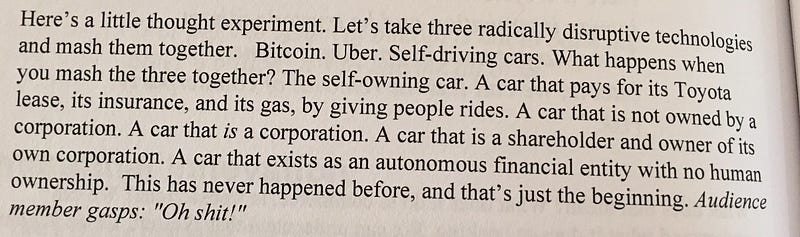
    30 things you can do with a blockchain 

    According to Gartner’s Hype Cycle 2016, is hovering somewhere near the peak of inflated expectations, and probably just about to fall off a cliff into the trough of disillusionment at any moment. All over the place, overblown ideas and proofs of concept oversold by those who really don’t understand how the technology works are colliding head-on with scalability challenges, industry-specific regulatory obstacles, dinosaur technology departments and corporate perceptions of events such as the Ethereum hard forks.

    As I said in a previous post, when overzealous innovation teams are claiming that blockchains can do anything you want them to, including making your morning cup of tea, it’s more important than ever to examine the problem your use case is solving and ask yourself whether it involves trust, consensus, immutability or an intersection of the three. If not, then you probably don’t need blockchain in the mix.

    However, it’s also important to remember that it’s borderline-crazy blue-sky kind of stuff that gets people thinking.

    When people outside the blockchain/ ecosystem start referencing discussions like this on /r/, you know that the possibilities are starting to sink in, even if reality hasn’t quite caught up yet.

    If we revisit this Medium in 2018, many of the 30 examples I’ve given here will be consigned to the dustbin of history. Some of them may already be dead on arrival.

    But the important thing was that someone, somewhere, saw the possibility of transformative power and seized the opportunity to try to make something new work. Seeing the glimmers of a nascent technology evolve is exciting.

    These use cases may not be fully realised towering edifices of technological excellence. But some of them may turn out to be the building blocks of our future world. And when we are plunged down into Gartner’s trough of disillusionment, it’s important to remember that.

    So, if you’ve ever wondered what you can do with a blockchain, here are 30 ideas:

    1. Transfer money
    Bitcoin has been described as “blockchain’s first use case”, and with good reason. For more than 40 years, since David Chaum’s DigiCash, economists have been seeking the holy grail of a digital currency that can eliminate the problem of double-spending and circumvent the issue of needing to trust an unknown third party. When Satoshi’s famous White Paper was published in October 2008, few people realised its impact at the time. Eight years on, the Bitcoin blockchain has still not been hacked — and you really need to try using it for yourself to realise how simple and how amazing the protocol is. The convergence of mobile payments, particularly in the African market, with cryptocurrency, is a niche to watch… companies such as BitPesa are leading the charge here. Read more about using Bitcoin here.

    2. Make micropayments
    Closely related to 1, the ability to use blockchains to transfer minuscule amounts of money is a potential game-changer. Whether you’re talking about in-app payments of a fraction of a cent, microgrid transactions or household appliances moving towards a pay-per-use rather than an ownership model, being able to make tiny payments using cryptocurrency without incurring bank fees that exceed the original payment is a huge opportunity.

    3. Lend people money
    Peer-to-peer lending is one of the fastest-growing areas in personal finance, with users attracted by the opportunity to make a return on their savings in a low-interest environment while enabling other users to borrow at a sensible rate — and all without giving the bank their cut. In contrast to fiat competitors such as Zopa and Funding Circle, BTCJam allows users to do all of the above, but with Bitcoin.

    4. Pay your parking fines
    Last year, New York City councilman Mark Levine suggested that recalcitrant motorists in New York should be able to pay for parking tickets not only with ApplePay, but with Bitcoin.

    No news yet on whether this will actually happen, but in the context of BitLicense, it’s an interesting aside.

    5. Consume content
    The rise and rise of ad-blockers has thrown the traditional business model out of the window. All-or-nothing paywalls have proved successful for a few publishers, but research has shown that users are more prepared to reward content creators if the process is seamless and if they can pay only for what they consume. Startups such as London-based Smoogs, Berlin-based SatoshiPay and Yours provide an easy way for writers, film-makers and other content producers to be paid for what they do. The groundbreaking Brave browser is yet another example.

    6. Charge an electric car
    Small, incremental payments are good for more use cases than just content consumption. Traditional car-charging stations normally require drivers to pay in fixed increments, regardless of how much electricity is consumed by the car’s battery. Additionally, for electric rental fleets, the hire company needs to develop software to track the charge left on the battery, or to do this manually. Imagine a system where every electric vehicle has a chip that allows it to pay directly for exactly the power it consumes, and where all the driver has to do is top up the payment allowance from time to time. German energy giant RWE developed exactly this pilot scheme with Ethereum pioneers slock.it, allowing electric cars to charge while waiting at the traffic lights. Read more about it here.

    7. Certify a supply chain
    Many consumers would prefer to make ethical choices about the products they buy. Recent scandals such as the sale of horse meat as beef in the UK, and revelations about the poor conditions of garment workers in developing countries has pushed this issue into the headlines. However, proving the origin of every component in a product can be impossible, and even if this information is held by a centralised authority, it may not be trustworthy. London startup Provenance offer decentralised supply chain certification. Read the white paper here.

    8. Share electricity with the neighbours
    It should be the easiest thing in the world to do. Take one street that has a sunny side and a shady side. The lucky people on the sunny side of the street have solar panels on their roof. It’s more efficient to use electricity close to where it is generated, so instead of selling the excess power back to the grid (which most networked domestic solar installations do), imagine if the owners of the houses with excess power could sell it on the local market. Unfortunately, this would normally come at a cost, with the homeowners having to agree a price among each other and monitor the amount of electricity being used. The MicroGrid project in New York’s Brooklyn solves this requirement by allowing the households to buy and sell energy via smart contracts on the Ethereum blockchain. No independent calculation or monitoring required.

    9. Prove your identity
    A reliable digital identity system is the Holy Grail of our connected world. We already live so much of our lives online, but it all comes to a grinding halt as soon as we need to somehow connect our carefully honed digital identity with our presence in the physical world, verified by some kind of government-issued paperwork or proof of existence at a particular address. Meanwhile, as we struggle to maintain our credit records and prove who we are to employers, or car rental companies, private corporations are making money from selling our data: data which belongs to us as individuals, and which we should be able to monetise. Too many organisations to mention are working on digital proof-of-identity schemes, many of them blockchain-based. Deloitte’s Smart Identity System is probably the best known .

    10. Let your household appliances pay for things
    IBM’s ADEPT [Autonomous Decentralized Peer-to-Peer Telemetry] research project was one of the first blockchain/IoT proposals, and certainly the highest-profile of 2015. The idea of a blockchain on which a household appliance is registered at the point of manufacture, and which has some kind of autonomous identity which it can use — for example — to purchase consumables such as washing powder, is a powerful one. As the white paper itself notes, scalability is (and remains) the major barrier: “A blockchain to cater to hundreds of billions of devices needs to be scalable…”

    The SPUR scheme under development by Quantoz is based on these principles.

    11. Prove ownership of an asset
    If someone steals your car in most countries of the world, there’s a reasonable chance it will be traced or recovered. Most governments operate some kind of registration scheme based on licence plate and/or chassis number. But what if your stolen possession is a bike? A jetski? A luxury handbag? A drone? Such high-value portable assets are easy to steal and also to remove from a particular geographic area where they may have been registered. Our startup Mamoru aims to provide a global standard for proof of ownership.

    12. Issue shares
    Overstock CEO Patrick Byrne is a long-time Bitcoin advocate, and the retailer already has its own issuance and trading platform, t0. At Money2020 this week, Overstock announced that stockholders would have the opportunity to subscribe for shares of its Blockchain Series A Preferred, which will trade exclusively on t0.

    “Through this public issuance of blockchain-based securities the history of capital markets is entering a new era, the era of blockchain-based securities,” said Byrne.

    13. Execute an equity swap
    Enterprise blockchain technology firm Axoni recently conducted a test of OTC smart contracts for equity swaps involving institutions such as Barclays, Citi and JP Morgan. “Using a blockchain you have a reliable record of who signed to the transactions and when each action was taken, so what you end up with is this distributed data store with a valid, provably gold version of the trade,” said CEO Greg Schvey

    14. Issue money from a central bank
    The idea of a cashless society is hugely appealing to governments around the world. Not only does it circumvent the need to print notes and mint coins, but it also means an end to the anonymity of cash, and provides a way to track the spending of individuals. Various central banks have flirted with the idea, but the Bank of England has gone as far as endorsing an independent study at University College London which proposed how cryptocurrencies might be issued by such an authority. Read the white paper and read my earlier Medium about why it’s different from Bitcoin.

    15. Smooth the shipping process
    Shipping across national borders generates so much paperwork that it can be measured in whole kg (or pounds, if you prefer imperial). When shipments are delayed, it can cause an impact on the whole supply chain as factories wait for components, and in some cases (for example, perishable goods), it can affect the viability of the whole shipment. Days of time and huge administration costs are tied up in producing bills of lading, so there was plenty of interest when shipping giant Maersk recently announced a blockchain-based bill of lading proof of concept.

    16. Authenticate sneakers
    San Francisco startup Chronicled hit the headlines when they partnered with high-end sneaker manufacturer Mache Customs to produce a range of smart-tag-enabled shoes in honour of Kanye West. Busting the counterfeit trade is one of their stated aims.

    17. Run a decentralised marketplace
    Open Bazaar is widely seen as a successor to Silk Road, but it is far more than that. Silk Road was a website on a server hidden by the Tor network. The FBI was able to track it down, seize the server, and arrest those involved. In contrast, Open Bazaar is a peer-to-peer network like BitTorrent. You can download the software and set up your own storefront. It’s worth mentioning that Open Bazaar does not explicitly endorse selling illegal items. From their FAQ: “Sellers on the OpenBazaar network host their own products and are therefore directly responsible for complying with local laws (and their own conscience) when listing items or services. Users engaged in illicit activity cannot hide behind a third party service.”

    18. Register music copyright
    Channelling income from music to the artist who created it is a huge global challenge. Often, the administrative costs of recovering royalties exceed the amount due. Friction caused by cumbersome payment processes mean that fans who would otherwise be prepared to pay to consume music end up illegally downloading content, just because it’s easier.

    Singer-songwriter Imogen Heap, assisted by various Ethereum people, announced the launch of Mycelia in July to address this problem. Billed as ‘fair trade for the music industry’, it aims to offer extra functionality such as allowing fans to pay for additional content, and targeted pricing, such as allowing charities to use tracks at a lower or zero cost.

    Swedish startup Zeptagram are also operating in this area.

    19. Vote
    The idea that we are still voting with pens and paper in 2016 is an anomaly. But electronic voting — whether at local or national government level, or in the context of corporations — is justifiably regarded with suspicion as the results seem open to manipulation without the relevant oversights. Because of the transparency offered by public blockchains such as Bitcoin or Ethereum, proponents of open government are vocal about the advantages of blockchain-based voting. Nasdaq has already announced plans in Estonia to allow corporate shareholders to vote and various startups are developing e-voting machines for state and national elections that work in a similar way.

    20. Register land rights
    Maintaining a national register of land ownership is an expensive and labour-intensive operation. Additionally, in countries where there is a history of government corruption, they may not always be trustworthy. Factom were widely reported to be working on a solution with Honduras to come up with a proof of concept for a blockchain-based land registry. This proved to be less concrete than originally reported and the project has stalled, but someone, somewhere will implement this one day.

    21. Execute a legal contract
    Code is not yet law! Remember this. But some legal firms are so convinced that one day this will be the case, that they are already making the first moves in this direction. London law firm Selachii have already announcedplans to launch digitised agreements based on blockchain technology.

    22. Run a prediction market
    The decentralised prediction market Augur is a brilliantly simple idea. Their platform allows you to make predictions by trading virtual shares in the outcome of events happening in the real world, such as the upcoming US election. If you buy shares in the correct outcome, you make a profit.

    23. Manage a swarm of robots
    This sounds pretty sci-fi, but is rather more based in fact than the title suggests. Increasing automation means that all kinds of industries, from farming to manufacturing, are now predicted to rely on large numbers of robotic labour. MIT Media Lab affiliate Eduardo Castelló Ferrer explains his rationale in this white paper.

    24. Manage healthcare records
    Think of any sector where there is an overriding need for untamperable data and a clear audit trail, and one of the first to come to mind is healthcare. Various startups are competing in this space, as this Bitcoin Magazine storydescribes, but one of the more interesting is the Factom/HealthNautica partnership in which they “are looking to secure medical records and audit trails. This is done by encrypting the data onto the Bitcoin blockchain with a timestamp to verify its accuracy. The records can’t be changed and, because it is hashed to the blockchain, it can’t be accessed without permission. HealthNautica hopes to improve efficiency of claims processing and certainty that the records have not been changed.”

    25. Certify students
    In a world with a mobile labour force, verifying academic qualifications (which are often needed for work visas) can be a slow and painful process. Vietnamese architect applying for a job in France? Russian developer seeking work in Germany? When universities have to be contacted individually and employer references verified over the phone or email, these processes consume time and money. Imagine a world where your certifications were written into a secure global data structure where they could not be deleted or altered. MIT wrote an interesting post about their certification architecture. Similarly, London’s B9Lab certify successful graduates of their excellent blockchain developer course with an entry into the Ethereum blockchain.

    26. Trade cryptocurrencies
    Bitcoin is not the only cryptocurrency! Hundreds of other cryptocurrency blockchains exist, although the majority of these are either defunct or carry virtually worthless tokens. A host of exchanges, some more reputable than others, have sprung up to cater for those which are worth trading: Bittrex, C-Cex and Poloniex are some of the popular options. Check out CoinmarketCap for an exhaustive list. And of course, I can’t resist mentioning my own altcoin portfolio tracker, CountMyCrypto. Since my friend Bruce and I launched it nearly three years ago, we’ve seen countless coins and exchanges spring up and die, and enough drama to put a soap opera to shame.

    27. Rent a car
    The car rental process is often more cumbersome than it needs to be, with insurance documents and identities that need to be verified, and vehicle mileages and damage reports that are still manually verified in many cases. This is how DocuSign described their smart contracts trial for car rental, in conjunction with Visa’s innovation team.

    28. Verify your work history
    Closely aligned with student certifications on the blockchain, the idea of a careers networking API based on a blockchain is one that’s been around for a while. At Mamoru, we’ve been working on this, since we won a BlockchainX grant from Wanxiang Blockchain Lab earlier this year.

    29. Get compensation for flight delays
    When the Ethereum DevCon2 conference happened in Shanghai earlier this month, attendees who flew to China from all over the world were notified of an interesting opportunity before the event. The Flight Delay dapp trialled a new proof of concept that allowed travellers to share the risk in the event of flight delays. Stephan Karpischek wrote a good post about the results of the experiment.

    30. Buy beer
    OK, so this is really a subset of use case 1, but you can’t be in Berlin and not mention Room 77. It’s a piece of cryptocurrency history, as the first bricks-and-mortar establishment anywhere in the world to accept Bitcoin. And, of course, it’s also a favourite haunt of Mamoru and all the other awesome Bitcoin and blockchain startups based in Germany’s capital city.


  • user 10:06 pm on November 4, 2016 Permalink | Reply
    Tags: , , , , , , , origin,   

    A brief history of cryptocurrencies… 

    the inevitability of crypto economy?

    Once every few generations, we get to witness a milestone in human progress, a phenomenon or an icon so rare and inspiring that it defies extrapolation of the law of averages, and all known expectations of what is extra ordinary. At inflection points such as those, humanity makes progress by leaps and bounds. Standards are re-set. Recall the invention / discovery of electricity, spacecraft, electro magnetism, antibiotics, Einstein, the smart phone, Usian Bolt, Nicola Tesla.. they inspire awe, stretch our boundaries, expand the human experience, and alter the way we live – forever!

    Our generation has been extremely privileged to witness more than a few such rare occurrences. Internet, Smart Phone and now . It’s as if we have achieved more technological progress in the past few decades than we have in the past several centuries. Not to belittle the foundations our forefathers and the great adventurers built and have bequeathed to us, but it is natural with any tipping point where progress accelerates manifold after gathering critical mass.

    While we have significantly leveraged the internet and miniature computing, past the hype and mass adoption, we are still at the cusp of a revolution with respect to cryptocurrencies, so my piece today will focus on what awaits us in !

    (If you are short of patience, skip and head straight to Blockchain India Summit 6 Dec 2016 in New Delhi and hear directly from Vitalik Buterin, Founder of ethereum)

    Ladies and Gentlemen

    I am going to spill some secrets tonite, and betray the parable of swiss secrecy, as one does on a high.

    I am high on Switzerland!

    You are probably tempted to think of some revelations of the personal kind, but the swiss mastery of money and time – “philarguria“, and “chronometry“/chronology“/”horology” the two biggest obsessions of mankind – that the Swiss have made industries of – is as fascinating. Not to mention the draw of great intellects and relativity theorists like Einstein and now the modern day cryptographers, to Switzerland. I have always held that pristine beauty and tranquility are conducive to attaining superior realms of thought and thereby pinnacles of creativity.

    Which explains the lure of Himalayas for many a world changing icon like Steve Jobs, though I couldn’t tell if Satoshi was as inspired by Switzerland as Vitalik. Anyway, if I were not Indian I would make it my home. Why, I have spent my most inspired moments here. Like when I was Vitalik’s age, I had taken my first ever international flight on Swissair to Zurich, and had been awe-struck by the experience seeing the gigantic imposing wooden doors of UBS for the first time. Years later I had returned to do my first ever investment banking deal – Hirslanden – for UBS. Years later I am about to do my first ever crypto stuff in Zurich again. So Switzerland is associated with deeply profound experiences, some romantic.

    I am going to argue in this piece for the inevitability of cryptocurrencies. Cryptocurrencies are to modern economics as the theory of relativity is to physics.

    Let us first visit the basics of money:

    What is Money?

    A form of promise – a promise to buy something of value

    A substitute for direct barter – instead of exchanging my sheep for your wheat bushels, I give you money

    A trust in a central party (like a Central Bank) that the currency note you carry will be worth some real value

    A form of exchange – you give me your services or time and I pay you money

    A factor in wealth creation, like labour – capital earns interest or can create wealth for its owner – capitalist economics

    Money as an investment / appreciating asset (like art or Gold)

    Let us for the time being ignore other philosophical definitions such as

    Money as freedom to pursue life’s lofty goals

    Money as a presumed substitute for immortality (a delusion of the rich that the more money they have the safer they will be)

    Money has been serving its various functions well since the babylonian times, and yet has evolved with each successive generation. In earlier centuries, for example, artists would create art for their masters in return for their patronage and being taken care of, and not money. But slowly, transactions have come to be more short termish than a kingly patronage and have had to rely on money for settling the exchange of value. So the modern day Emir of Dubai or Oman would give his humble vassals wads of cash or write a cheque instead of promising his life long patronage.

    The origin of cryptocurrencies

    The concept of crypto money took life in 1997, when Nick Szabo invented hashcash. If anyone knows who Nick Szabo is, I am very keen to meet, if only to ascertain if he is Satoshi, and if he ever sent me a few emails. I discarded the possibility out of fear of being proved gullible by a fake Satoshi, and never took up my email “Satoshi” on the offer! As a solace, the rest of the world also knows Satoshi only by email! 😛

    was the first real form of crypto money as opposed to digital cash – for example Paypal. Ofcourse Facebook money, QQ coins, and coins in virtual games all made their remarkable debuts but these fancy coins were seen mostly as a means for the wealthy (chinese?) to splurge on the ridiculous and the inconsequential, besides robot cafes offering forbidden pleasures, you know what I mean. None of the currencies went so far as to be treated a substitute for real money. Facebook even applied for a banking license in Ireland wanting to capitalise on FB messenger being a platform for peer-to-peer cross-border payments (these constitute a significant chunk of global remittances market of US1 trillion a day as per BIS).

    Bitcoin was the first money to solve the problem of trust in a trustless environment – The Byzantine Generals Problem – How can parties transact and establish trust, in face of non-verifiability and when all parties cannot be trusted. As all masterpieces go, Satoshi had combined together several disparate concepts in creating bitcoin. Obviously he had to have deep mastery of all subjects to come up with this invention, which has been fascinating technocrats as well as the cult of wall street.

    Bitcoin has been a preferred mode of investment for some people, from every strata, including some retirees who chose to put their entire nest egg in bitcoin. One of the early bitcoin believers had told his friend – you will either lose all of it, or make a fortune like 1000X. Invest as much as you can stomach the loss! Interestingly, Satoshi himself had never spent a single bitcoin he had mined, as was discovered by an Eastern European developer who was tasked and paid to research this. And Satoshi had amassed bitcoin equivalent to millions of dollars as he had to keep the mining operation going singlehandedly, early on. Infact there were only two miners at the beginning for the better part of the first year, and the early months had just been Satoshi’s server. That he didn’t invent bitcoin for his own benefit speaks of his selfless movie in giving the world his open source gift. For anyone familiar with the mystical, this is self-evident – nature only bestows special gifts and privileges on people who would pass on their gift for the maximum benefit.

    As it turns out, Bitcoin is also a form of protection against inflation for hyper inflationary countries, like any appreciating asset. One of the early bit coiners (Wences Casares, Founder of Xapo and Board member of Paypal) as a young boy would run into an Argentinian store with his family, grabbing all they could for the money his mom had just received in salary, so that they could maximise the value of goods purchased – in the face of hyperinflation. There was no concept of saving for tomorrow, because a few minutes later, the same notes would buy significantly less food as store keepers went around the aisles all the time rewriting price tags. Real story!

    As a tribute to the genius of Satoshi, here is my attempt to decrypt his magic recipe of bitcoin.

    Bitcoin is a cult!

    Decentralisation – Satoshi’s first ingredient:

    Satoshi essentially solved the problem of centralisation. A handful of people in the world got to decide how much money would be in circulation at any point (monetary policy), how much would its relative value be vis-a-vis other currencies, are people spending too much or too little and how to mend that (fiscal policy), how much would be the time value of money (interest rate), and what do people have to give up by way of data and privacy (endless KYC and identity verifications and intrusion into private affairs) in order to spend their money (yes you read it right – I didn’t say what people have to give up in order to earn money, but to spend money!)

    If people could determine with zero error if money had indeed changed hands between parties and by how much, through alone, without having to trust each other or any third party like a central record keeper, it frees people from the tyranny of watchful big brothers. And if I may add, greedy, power-hungry, self-aggrandising actors (if not dictators) on rotation – in the form of elected governments. Oligopolies who want to make money off your money spending transactions. With bitcoin, people can choose how and when they spend without a concern for informing anyone else about it – which many would agree “informing” amounts to slavery or extortion or restriction of liberty or all of the above.

    The magic is that Satoshi achieves decentralisation through a mere technology protocol. A protocol that combines cryptography, mathematical functions, the economics of incentives in markets and game theory. There may have been bugs in code, as Satoshi himself encouraged other developers to fix and even go so far as to take ownership of the protocol but the code is essentially robust, and bitcoin code today contains supposedly only 15% of Satoshi’s original code.

    Now experts are anticipating “segwit activation” on bitcoin code to happen in 2016, which will enable “Lightning Network” to speed up transactions on the original bitcoin – whose 10 min Block interval had been a bottleneck for many, especially financial institutions. The earlier drawbacks of bitcoin – such as slow Block Verification – had been leveraged well by some firms such as Bitfury with their Lightning protocol and side chains. Bitcoin Blockchain is by far the most robust Blockchain, having been tested, bug-exposed, and reengineered by fervent believers espousing the cause of decentralisation. Bitcoin is no longer a currency or a technology, it is a cult! With Lightning embedded on top, the current Bitcoin Blockchain will give a tough fight to many fledgling and newer well-funded blockchains. Afterall, Cult figures are difficult to dethrone, no matter how nimble and powerful the imitators. Satoshi Nakamoto is a cult, and so is bitcoin!

    I am not speaking yet about the blockchain or its benefits of faster, cheaper, frictionless transactions upending intermediaries in every industry, and am restricting my arguments only to bitcoin so far. See more bitcoin drama here. Read my piece on blockchain herehttps://www.linkedin.com/pulse/besotted-blockchain-arifa-khan and the sequel here

    Cryptography – Satoshi’s second ingredient:

    Cryptography and trap-door functions involving prime numbers and factoring, were applied to device public and private keys – a combination of which would enable you to unlock a bitcoin but make it impossible for you to reverse engineer a private key from a public key – thereby ensuring safety and irreversibility of a bitcoin transaction.

    Game Theory – Satoshi’s third ingredient:

    Since the mining operation is computational and energy intensive, what if some miner or a mining group amassed enough power to subvert the process to his benefit – aka the 51% hash attacks? Satoshi figured that for a serious miner playing for long term stakes, it is important that bitcoin’s value is sustained through confidence of the market and players. Any attempt by a player to abuse the process will result in bitcoin losing value, which would not benefit the rogue miners in long run. Ofcourse many hackers got away with blackmail ransoms from founders like Stephanie Kent who were blindsided by attacks on their chains. But those outcomes for hackers were not the Game theory Maxima, and the Nash equilibrium of bitcoin in long term does point to a sustainable bitcoin economy and thereby, an appreciating bitcoin – as has been proven by bitcoin price charts.

    Macroeconomics – Satoshi’s fourth ingredient:

    Satoshi foresaw that for the hashing to go on indefinitely, miners had to be incentivised by rewards (bitcoin) for carrying out the computational processing. He also took into account demand-supply dynamics of hashing power, and accommodated in his code self-adjusting difficulty level of computations required for arriving at the winning hash so as to keep the time interval between blocks a constant ~ 10 minutes. As he had anticipated, the early community actively engaged in upgrading the code, discovering and fixing bugs as it was open source – bootstrap nodes were introduced as an example to defend against DDOS attacks, and rogue miners hijacking the wrong fork of the blockchain.

    Smart Contracts as a way of Record-Keeping— Satoshi’s futuristic fifth ingredient:

    Satoshi had apparently studied money so thoroughly that he wanted to accord bitcoin the features of money as a tool for record keeping too, besides as a token of value or means of transfer. In Babylonian times, contracts were recorded on clay tablets as to how much one owed the other and when.

    (Image of ‘A tablet from the Babylonian times’ – Prof Willi Brammertz Author of Unified Financial Analysis explaining Financial Contracts to me)

    The complex hieroglyphics are thought to be the first form of record-keeping or accounting. To store 1MB of data in Babyloninan times would have taken a warehouse of several football fields and to transfer this data would perhaps take a ship physically ferrying these clay tablets across distances. The contracts were just a record, and depended on the good nature of the contractual parties or the fearsomeness of a central authority for execution. Satoshi now conceptualised a foundation for contract which depended on neither the goodwill or generosity of the counter party nor the authority of an intermediary to execute. The contract, with its collateral of cryptomoney in escrow, would irreversibly tilt the outflow of the underlying asset from one party to another, based on the outcome of a pre-determined function. Prof Willi demonstrated to me that all financial contracts currently in existence in the world can be explained by just some 30 patterns – so very amenable to Smart Contracts.

    He visualised that this protocol would enable self-executing financial contracts to be embedded in code, and thereby obviate many other forms of centralisation such as the legal profession, notaries, securities exchanges etc. However, he was content to leave bitcoin code simplistic, in order to achieve more code robustness – to withstand any malafide attacks and bugs.

    Disclaimer: I haven’t read Satoshi’s original paper. If I do, I hope to be able to decipher unspoken magic beyond Smart Contracts. If I go recluse, it would be because Satoshi will have sworn me to secrecy. 🙂

    The history of Cryptocurrencies

    Bitcoin is the world’s favourite , as a wide variety of players around the world have embraced it as an investment vehicle. It competes with real investments like real estate, gold, precious metals, art, jewelry, fiat currencies.

    Hundreds of Remittance startups around the world have bitcoin rails supporting their FX remittance operations (buying and selling in the background which creates demand supply for bitcoin). 1000s of merchants in Africa and countries with hyper inflation or unstable currencies prefer to accept bitcoin over fiat.

    Nearly 600 cryptocurrencies have been issued so far, since Satoshi gifted us the ‘bitcoin’ in 2009, and are now again back in the limelight. Zooko & Co have just launched Zcash (@zcashco) – a variation of bitcoin with absolute anonymity (no pseudonymity). The bitcoin price currently at $710 as of 30 Oct 2016 (having appreciated wildly in the past week with the hype around launch of new crypto “Zcash”) is expected to touch $1000 in 2017. Bitcoin has ridden the crests of human imagination at a scale never before witnessed, as one of the most fascinating man-made phenomenon of 21st Century. Bitcoin has survived drama of Shakespearean proportions. One investor who had put all his retirement savings in bitcoin early had lost it in one swoop when MtGox went belly up in 2014, losing a collective $400 million of its investors wallets in compromised security.

    ZCash or ZEC works on a similar algorithm to bitcoin with the same 21 million ZECs to be issued during the lifetime etc, but 10% of which would be set aside and issued to stakeholders like founders, investors etc. Bitcoin was not entirely anonymous as its early adopters thought, as was proven by the anti-climax of Silk Road. Nor was ethereum’s DAO safer than a dozen put together, as a hacker proved – resulting in the hard fork that split ether into ETH and ETC.

    Many companies use cryptography in varying context. blockchain.info wallet only holds crypto files to encrypt and decrypt private keys and does not really hold the bitcoins in the wallet, thereby eluding regulation and also the licenses required for holding e-money. Nicolas Cary, CEO, is an oft quoted figure in bitcoin annals, a bundle of energy, and is a pleasure to listen to.

    Now Zcash would be entirely anonymous. Enough to justify its futures trading price at 1.5BTC, when it hadn’t even begun trading? When it was launched, one report pegs the traded coin value at USD7000 , an eye-popping number given the highest bitcoin ever reached was ~ USD1000.

    Cryptocurrencies – an inevitability of Modern Economics

    You can now spend your crypto with absolutely no traceability. This would give the transaction finality of cash. You spend it and forget it – the original raison d’être of money. No need to maintain bills, accounting, or record the spend on a clunky blockchain. Take privacy back from the Governments, the Amazons, the Paypals, the Visas, Facebooks, Squares and Banks who horde all this data about your faintest digital trails and your minutest personal proclivities. Interesting anyone? You bet! It finally dawned on me why all the rich guys insist on spending only in cash everywhere. I am talking of respectable and responsible PE investors & the Valley kings, not just the flamboyant types.

    Behold another variation at the opposite extreme of Zcash! A new coin wants to be the cryptocurrency with zero anonymity. You can always associate this coin with its owner’s identity. This is a play to serve the excessively cautious regulators and Central Bankers who would be loathe to give up on their KYCs and citizen accountability, much like Accenture wants to serve the Bank market who would love to get on a Blockchain lest they get taken over by Silicon Valley, but would be loathe to give up their control of data, and keep it mutable.

    Then there are the architects of circular economies like the Solar coin, Diamond coin, Gold coin. Many firms are offering tokens/ coins at their ICOs such as Decent, Apptrade (Initial Coin Offerings are equivalents of IPOs in Crypto but no investment bank determines the subscription price). Apptrade is a stock market exchange for new DApps.

    As eventful as my research goes, I met someone claiming to be the patent holder being infringed upon by – hold your breath – Apple, Samsung, and now Ethereum.. and he needed me as saviour to restore his rightful intellectual property and the billions (in dollars) to follow. Anyway, I happened to be in a conversation trois – at a swiss bar between the geek and Andreas Antonopoulos on patents & decentralisation. (I checked with another friend for a word for conversation between three – just so I wouldn’t accidentally mention the wrong menage and he goes “if you are part of the conversation, then its called “a monologue with two listeners“! hmm.. With friends like that, do I need detractors?) I caught Andreas, the author of “Internet of Money”, in a lighter moment in an impromptu conversation informelle and asked him why he thinks cryptocurrencies are inevitable. I quote him verbatim –

    "The architecture of centralisation is antithetical to the principles and interest of society. Patents and any intellectual property is passe and will be outdone by open source as it is more conducive to innovation, and will garner more support as it is philanthropic. All my life, I have been against patents. This century is about decentralisation. So cryptocurrencies are here to stay!" Andreas Antonopoulos 
    

    Why will Crypto Currencies succeed?

    • We are tired of paying fees, and customers will revolt when faced with superior customer friendly options
    • We are tired of being surveillanced, and we will fiercely guard our privacy and interest when faced with more secure options
    • Why do we have to supply onerous information when we decide to send or spend our own money? We tend to adopt the easier and more discreet options.

    In a face-off between Wences Casares and Bill Gates, Wences had managed to convince an initially skeptical Gates that bitcoin was the tool for getting a bang out of his buck spent uplifting poor nations, and putting power back in the hands of the impoverished and unbanked. Bill Gates bought into that pitch. Alas, Wences just told me he can’t make it on 6 Dec to India – a favourite of every philanthropist trying to make a dent in the universe! Soon Wences!

    Switzerland and its historic relationship with money (not a tryst)

    Then there is the history of Switzerland as a storehouse of money. Even during the world wars, the wealthy chose Swiss underground caverns for preserving their wealth, as Switzerland has forever been a neutral peace-loving country more focused on being the world capital for banking, engineering precision, ultra luxury craft, hospitality, private schools and sanatoriums. Famous for its secrecy laws, the Swiss rarely concede to authorities as formidable as even the FBI. In keeping the tradition, The SBB (my favourite Swiss Bahn Railway) will be opening up its 1000 ticket kiosks as bitcoin ATMs on 11 Nov 2016.

    Recognising Switzerland’s potential to emerge as the hub of crypto economy, Blockchain Storm hosted a roundtable discussion in Geneva on 30 Sep 2016 with authorities on distributed ledger technology such as Brian Behlendorf of Hyperledger, Bruce Pon of Bigchain, Eddy Travia of Coinsilium etc, which I moderated. We all agreed on the merits and the inevitability of crypto economy and that we now needed to work on interoperable systems and standards. So we will be gathering again in 2017.

    Switzerland could emerge as a cauldron of unimagined combination of industries and academia – asset management, banking, crypto economy, precision engineering, luxury goods.

    Many firms have made their home in crypto valley, Zug – perhaps for proximity to ethereum. Sample a bitcoin investment bank – “bitcoinsuisse”. If you wonder what CEO Niklas Nikolajsen looks like in real life, he had all the panache of a real investment banker spreading his fiat notes including a collectors’ item – A 100 SFR from centuries ago – on the table of a bar. How is that for a conversation starter? I remembered being in Copenhagen years ago on a deal, when my investment banking colleague Diamandakis had just given me a wad of cash and asked me to play at the Casino. I remember winning big at the tables that night, and feeling like Bond girl! And of course enjoying the high of a banker! We bankers are hopeless Adrenalin chasers! Years later, he was still surviving the credit crunch as a lone Director who held forth at Credit Suisse, long after many of his peers had ‘left’. Says something about human nature and the importance of making people happy as a secret of success in banking and elsewhere!

    "Future of cryptocurrencies is bright. It's what we have been waiting for. The cheaper, faster, better system always wins. First came the internet which liberated data. Now comes Blockhain which will liberate value." - Niklas Nikolajsen, CEO bitcoinsuisse as told to Miss Khan
    

    Caution : He could do this in Switzerland (display all forms of money old, new and crypto at a bar), but don’t try it elsewhere 😛

    Now there are dozens of companies leveraging the swiss reputation as trust- keepers and managers of money. So much so that whenever a famous world leader dies or takes seriously ill, legends abound of their nearest kith and kith reaching first for their personal effects supposedly storing the password to their swiss account, before they consider anything else. So the Swiss had outdone Satoshi in private keys long before cryptocurrencies would become a global fashion? And they had combined it with their other passion for fine luxury crafted jewellery? Luxury Jewellery – a perfect draw for women, in turn a perfect draw for… Any Crypto Lord listening? 😛

    Woman is the Oasis of Life!

    Consider this tagline – Cryptocash – for cold bitcoin storage in swiss mountains. (I’d head there in a jiffy!)

    The rise of Cryptarchs

    Want to mint your own Cryptocurrency?

    There are some things that cannot be cryptoed, but for everything else there is Batman. (Thank you MasterCard – your only legacy in a few years may be your clever advertising)

    Input Output (IOHK) is a firm specialising in cryptocurrencies, ICOs and circular economies, the stuff where minting your own crypto is still a legitimate way to create wealth, and also to make yourself famous – while the fable of crypto is still an intriguing mystery. If you have an idea for another wildly successful crypto – consult with Batman in the guise of Charles Hoskinson, a fine mathematician, a person exuding eloquence on esoteric subjects, and great authority on all things crypto. We are pleased to be hosting him at our Blockchain Storm – Cryptocurrencies & Modern Economics – 20 January 2017 in collaboration with Swiss Finance Institute at University of Zurich.

    All systems have been created by people no better and smarter than ourselves. We don’t have to accept them as fait accompli! –Charles Hoskinson

    Charles, you can thank me later. But, where’s my crypto? 😛

    IC3 – Initiative for Cryptocurrencies & Contracts

    Lending cryptos their respectability is IC3 – an academic consortia led by Cornell University – which I was very privileged to receive an invite to join! Well, hobnobbing with academia has it’s benefits! Which brings me to our partnership with Swiss Finance Institute at University of Zurich, the university which employed Einstein as a Physics Professor in 1909. We are pleased to be hosting a “Cryptocurrencies & Modern Economics – Blockchain Storm Switzerland” event at Uni of Zurich on 20 Jan to bring together banks, academia and crypto economy stakeholders to take the debate to the next level. I chose Zurich, the world capital & Mecca of Banking as the destination for its concentration of intellect as well as assets under management, and for crypto valley – home of many game changers in open source protocols. Zurich is now interestingly the confluence of old money and new bleeding edge inventors. Be there at University of Zurich to herald 2017, the year that cryptocurrencies emerged as mainstream.

    The legend of Vitalik Buterin

    I am also playing hostess to India’s first ever Blockchain Summit http://europeindiaconclave.com, with the rare privilege of presenting Vitalik Buterin to India, alongside many distributed ledger technology firms from co-founders of Ethereum. India is eager to make the best of blockchain and welcomes Vitalik (read more about Vitalik in my Daily Pioneer article here). Zero Field Labs will be the bridge between Indian firms and Distributed Ledger Technology expertise in the west, and will also set up an Academic Excellence Centre on Blockchain in partnership with Indian Institute of Technology, my alma mater. We will also announce Blockchain Council India to work with the rule-makers on policy issues. I hope to have the regulator on stage for views on just what will be allowed and encouraged in India – given bitcoin is borderless and , by its very design, resists patrolling by powers-that-be.

    I might consider giving a keynote on “India’s Climb to becoming an Economic Super-Power – What would I do as a Macro Economist”. I would be happy to host Senior Ministers at such a gathering, and hope the importance is not lost on rule-makers in the protocol maze.

    Bitcoin is a mystery that never ends, wrapped in sequinned layers, beguiling a whole generation of crypto suitors.

    The coming generations will remember the legend of Satoshi Nakamoto as a man who singlehandedly reduced a whole planet of rule makers to bedazzled spectators watching a real sci-fi thriller, with their hands tied. And being an object of Satoshi’s attentions (if not the object), however questionable the claim, gives me bragging rights 😛

    You see, I have a rival in bitcoin!

    About the Author

    Miss Khan, the author, dedicated a significant chapter of her life, as investment banker executing Leveraged Buy-outs for Private Equity firms, at two bastions of swiss banking – UBS and Credit Suisse, after obtaining a MBA in Finance at Wharton Business School, University of Pennsylvania. Miss Khan is an avid blockchain researcher and speaker at various international forums such as Payments International. She advises Govt. of India on international financing. She has now identified her favourite destination Switzerland – as also a hub for people that will go down as legendary historic figures in the evolution of money – cryptocurrencies.

    She lives in London. She paints for recharging, and photographs Switzerland. Meet her in New Delhi 6 Dec 2016 at http://europeindiaconclave.com with Vitalik , and in Zurich 20 Jan 2017 http://blockchainstormzurich.eventbrite.com with Charles Hoskinson. Follow her @misskhan

    True to the spirit of sublimely Swiss, this piece was created on panoramic trains, charming rides on country roads, tete-a-tetes at chocolate places, tram rides to a quaint strasse where Einstein once lived, all soaking in excessive beauty of Switzerland. She marks this para as being penned on a very refreshing ride from Zurich to Luzerne which had turned rather chilly by nightfall on return.

    Season’s Greetings

    Happy Diwali

    Miss Khan is CEO of Zero Field Labs, a crypto economy play.

     
  • user 3:36 pm on November 4, 2016 Permalink | Reply
    Tags: , , , , , , ,   

    SBB and Bitcoin: Did You Just Notice The Gorilla On Stage? 

    You may all know the now-famous experiment conducted in the late 1990s by Daniel J. Simons and Christopher Chabris where two groups of people – some dressed in white, some in black – are passing basketballs back and forth. The study subjects were asked to count the passes among those dressed in white while ignoring the passes of those in black.

    Gorilla

    They found that many of those who viewed the video failed to when a person in a suit suddenly walked into the game, faced the camera, pounded on its chest and then left the . The gorilla was on screen for over eight seconds, yet half of those who watched the video didn’t see it.

    Did you notice the Gorilla this time?

    Well, the so called Monkey Business Illusion happened again when SBB, the Swiss Federal Railway operator, decided to extend its &;Service Publique&; in Switzerland on 11 November 2016. Where the seemingly &8220;omitted&8221; to serve the public on their ATMs, SBB ventures to close the gap. A new era of state-driven revolution has begun: Our government owned SBB is entering the brokerage business!


    SBB is pushing Bitcoins mainstream

    &8220;Make quick and easy purchases with Bitcoin&8221; is the bold statement on the SBB website. The business model of SBB CEO Andreas Meyer seems quite smart. A simple software update on the ticket machines and SBB is ready to earn its share on the 6% commission of each bitcoin sale. It would in fact be very interesting to know from SBB what type of goods are indeed so easy to buy with Bitcoin that someone is willing to pay a 6% commission for. Anyway, this is a different story.

    Bitcoins might actually go mainstream!

    Is it really the time to cheer for another FinTech innovation? Maybe we should pause for just a second. Let&;s think of it again: A state-owned company is selling an alternative, virtual currency to the Swiss public that promises to replace our financial system with all its established control mechanisms to ensure price stability, prevent money laundering, terrorist financing and tax evasion and completely undermines upcoming new measures like AEI etc. Of course, the current system is not perfect. But who can guarantee when and whether a financial system based on Bitcoin will ever be stable and secure enough?

    What will happen when suddenly people of all age classes get access to Bitcoins on hundreds of SBB ticket machines? Nobody really knows yet. But one thing should be clear, this is not just the reinvention of the old Swiss WIR currency, a form of digital money backed by Swiss francs. Bitcoin is playing in a wholly different league.

     It&8217;s not about Swiss law, it&8217;s about our economy & reputation

    In Switzerland, contracts with cryptocurrencies are enforceable and penalties can be imposed for criminal offences. The Zug based company Sweepay is acting in the background as financial intermediary and the setup fulfils the requirements emposed by FINMA and the Swiss Anti-Money Laundering Act. So, where is the problem?

    Sweepay

    It&8217;s not about the law, it&8217;s about the fact that this is the first time in the history of mankind where a might actually go mainstream in a country and test out its romantic promise of a better world on an unprepared population. There haven&8217;t really been public debates in Switzerland outside of FinTech expert circles. The Swiss economy and its people shouldn&8217;t be lightheadedly used as guinea pigs for a virtual currency rollout fuelled by a state-owned company.

    Switzerland&8217;s reputation and its sound financial center with an ever more flourishing FinTech industry are carelessly put at risk. Maybe some Bitcoin firms will benefit but maybe many other FinTech players will soon loose their businesses or turn their back to a country that just lost control on its price stability. Who really knows about the side effects of Bitcoin in a complex real-life economic system?

    bitcoin

    And what about consumer protection?

    The financial industry has undertaken huge efforts in recent years to better protect the customers against risks and provide them with appropriate information. However, it&8217;s not clear whether there will be any risk disclaimers at all on SBB ticket machines. But imagine if all potential consumer risks would have to be disclosed before buying any Bitcoins. How would you explain to a 14-year old teenager that he better shouldn&8217;t spend all his pocket money on these interesting darknet products like anabolics and narcotics while on the other hand not spending the Bitcoins might suddenly result in a total loss of value?

    Let&8217;s build a safe financial system based on a solid cryptocurrency

    Cryptocurrencies have many advantages over fiat currencies. But I still prefer to entrust our economy to some type of a &8220;Utility Coin&8221; that ensures to actually deliver all of the advantages of a promising new technological concept without all of the obvious and potential side-effects of Bitcoin.

    Let&8217;s properly prepare for such a transition process before we carelessly risk to &8220;Trump&8221; into an economic disaster. And please &8220;like&8221; this post if you even slightly doubt that SBB brokered Bitcoins are completely risk-free.

    This article first appeared on LinkedIn Pulse

    The post SBB and Bitcoin: Did You Just Notice The Gorilla On Stage? appeared first on Fintech Schweiz Digital Finance News – FintechNewsCH.

    Fintech Schweiz Digital Finance News – FintechNewsCH

     
  • user 3:36 pm on November 4, 2016 Permalink | Reply
    Tags: , , , , , , ,   

    SBB and Bitcoin: Did You Just Notice The Gorilla On Stage? 

    You may all know the now-famous experiment conducted in the late 1990s by Daniel J. Simons and Christopher Chabris where two groups of people – some dressed in white, some in black – are passing basketballs back and forth. The study subjects were asked to count the passes among those dressed in white while ignoring the passes of those in black.

    Gorilla

    They found that many of those who viewed the video failed to when a person in a suit suddenly walked into the game, faced the camera, pounded on its chest and then left the . The gorilla was on screen for over eight seconds, yet half of those who watched the video didn’t see it.

    Did you notice the Gorilla this time?

    Well, the so called Monkey Business Illusion happened again when SBB, the Swiss Federal Railway operator, decided to extend its &;Service Publique&; in Switzerland on 11 November 2016. Where the seemingly &8220;omitted&8221; to serve the public on their ATMs, SBB ventures to close the gap. A new era of state-driven revolution has begun: Our government owned SBB is entering the brokerage business!


    SBB is pushing Bitcoins mainstream

    &8220;Make quick and easy purchases with Bitcoin&8221; is the bold statement on the SBB website. The business model of SBB CEO Andreas Meyer seems quite smart. A simple software update on the ticket machines and SBB is ready to earn its share on the 6% commission of each bitcoin sale. It would in fact be very interesting to know from SBB what type of goods are indeed so easy to buy with Bitcoin that someone is willing to pay a 6% commission for. Anyway, this is a different story.

    Bitcoins might actually go mainstream!

    Is it really the time to cheer for another FinTech innovation? Maybe we should pause for just a second. Let&;s think of it again: A state-owned company is selling an alternative, virtual currency to the Swiss public that promises to replace our financial system with all its established control mechanisms to ensure price stability, prevent money laundering, terrorist financing and tax evasion and completely undermines upcoming new measures like AEI etc. Of course, the current system is not perfect. But who can guarantee when and whether a financial system based on Bitcoin will ever be stable and secure enough?

    What will happen when suddenly people of all age classes get access to Bitcoins on hundreds of SBB ticket machines? Nobody really knows yet. But one thing should be clear, this is not just the reinvention of the old Swiss WIR currency, a form of digital money backed by Swiss francs. Bitcoin is playing in a wholly different league.

     It&8217;s not about Swiss law, it&8217;s about our economy & reputation

    In Switzerland, contracts with cryptocurrencies are enforceable and penalties can be imposed for criminal offences. The Zug based company Sweepay is acting in the background as financial intermediary and the setup fulfils the requirements emposed by FINMA and the Swiss Anti-Money Laundering Act. So, where is the problem?

    Sweepay

    It&8217;s not about the law, it&8217;s about the fact that this is the first time in the history of mankind where a might actually go mainstream in a country and test out its romantic promise of a better world on an unprepared population. There haven&8217;t really been public debates in Switzerland outside of FinTech expert circles. The Swiss economy and its people shouldn&8217;t be lightheadedly used as guinea pigs for a virtual currency rollout fuelled by a state-owned company.

    Switzerland&8217;s reputation and its sound financial center with an ever more flourishing FinTech industry are carelessly put at risk. Maybe some Bitcoin firms will benefit but maybe many other FinTech players will soon loose their businesses or turn their back to a country that just lost control on its price stability. Who really knows about the side effects of Bitcoin in a complex real-life economic system?

    bitcoin

    And what about consumer protection?

    The financial industry has undertaken huge efforts in recent years to better protect the customers against risks and provide them with appropriate information. However, it&8217;s not clear whether there will be any risk disclaimers at all on SBB ticket machines. But imagine if all potential consumer risks would have to be disclosed before buying any Bitcoins. How would you explain to a 14-year old teenager that he better shouldn&8217;t spend all his pocket money on these interesting darknet products like anabolics and narcotics while on the other hand not spending the Bitcoins might suddenly result in a total loss of value?

    Let&8217;s build a safe financial system based on a solid cryptocurrency

    Cryptocurrencies have many advantages over fiat currencies. But I still prefer to entrust our economy to some type of a &8220;Utility Coin&8221; that ensures to actually deliver all of the advantages of a promising new technological concept without all of the obvious and potential side-effects of Bitcoin.

    Let&8217;s properly prepare for such a transition process before we carelessly risk to &8220;Trump&8221; into an economic disaster. And please &8220;like&8221; this post if you even slightly doubt that SBB brokered Bitcoins are completely risk-free.

    This article first appeared on LinkedIn Pulse

    The post SBB and Bitcoin: Did You Just Notice The Gorilla On Stage? appeared first on Fintech Schweiz Digital Finance News – FintechNewsCH.

    Fintech Schweiz Digital Finance News – FintechNewsCH

     
c
compose new post
j
next post/next comment
k
previous post/previous comment
r
reply
e
edit
o
show/hide comments
t
go to top
l
go to login
h
show/hide help
shift + esc
cancel
Close Bitnami banner
Bitnami